Podcast 302: Back to (Ski) School with Kathy Brennan
Skiing with a pro helps assess your skiing and overcome challenges at any age. Instructors are trained to recognize disruptions to skiing common among seniors and help them. Many skiers find joy as instructors later in life. Kathy Brennan of PSIA-AASI Eastern Region is our Gold Skis Podcast guest.
Full Transcript. AI, translated the transcript so let us know if it needs improvement.
Colleen Cardarella: 00:02
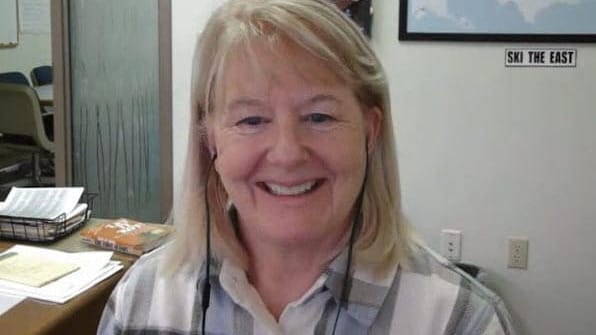
Everyone, welcome the Gold Skis Podcast, episode 302. Our guest today is Kathy Brennan. Kathy is a veteran of the snow sports and resort industries. She has a lot of experience in helping organizations to define new systems and processes and to develop their leaders. Some of her many career highlights include technical director at Waterville Valley, CIO and Services Director for Wales and Tales Water Park, and Alpine Adventure Zipline. She has over 30 years of experience as a member of PSIA and AASI, including serving as an examiner and a development team coach. So I met her through through PSIA. I took her Women's Mogul Clinic at Killington. I've got to say it's one of the best courses I've taken, really improved my skiing, and it was just a fun two days. She's she's got some really good jokes, just a good group. So in 2021, she did what we all hope to do. She landed her dream job, her dream job at Snow Sports. She is now the CEO for PSIA and AASI East. And she's really crushing it there, and I'm excited to have her as our guest today. So welcome, Kathy.
Kathy Brennan: 01:12
Thank you so much for having me, Colleen. I'm excited to be here with you today.
Colleen Cardarella: 01:16
Most people in our audience, I think, know what PSIA and AASI is, but not everyone may. So why don't you just tell us a brief overview about it?
Kathy Brennan: 01:29
Awesome. PSIA Professional Ski Instructors of America, AASI, the American Association of Snowboard Instructors, and we are a national organization. There are eight regions across the country, and then a national organization that kind of sets our standards that's based in Colorado. So I head up the Eastern Region, which runs from Maine all the way down to the Carolinas, and about far west as western New York and Tennessee. And we are an education certification organization. We are a community of like-minded pros. It's an opportunity for engagement in education and to chance to improve our skills so that we can attract and retain participants, students who are taking lessons from us at their resorts throughout the region.
Colleen Cardarella: 02:22
Great. So you talk about that education and certification. I know you know myself teaching skiing over the years, I really focused in on some disciplines in adaptive. There's a lot of different ways that you train people, not just around skiing, but around working with different populations. And there have been programs added over the years around working with the senior community, which is which is you know our gold skis community. So can you talk a little bit about how those programs have come about and what you're doing with senior training?
Kathy Brennan: 02:57
Absolutely. Well, you know, frankly, many of our members, the average age of my membership, I've got over 10,000 members in my region. And the average age is about 55 years. And and also when we look at the demographics out there, there are certainly a lot of young people that are coming to into the sport, but there's a lot of folks that that either learned a long time ago that are still active, or people who are now in their retirement taking up the sport. And so we're seeing participants aging as well. That's driving a lot of the demand. There's some great programs out there, and I think when we have more knowledge about how we want to adapt what we do, how we're using our equipment, the choices that we're making out on the hill, that allows us to participate more well into our later years. And so what we're trying to do is to provide some education to our membership so that they can then share that, you use that for themselves, but then also to share that with the community so that they can participate safely and enjoyably.
Colleen Cardarella: 04:06
So what are some of the challenges that you find senior skiers may have that are unique to them when they come to a lesson?
Kathy Brennan: 04:16
Well, I'm not entirely certain it's unique to them. You know, I like to think of every lesson as being adaptive. Everybody's got something that we're trying to adapt for. But I do think for seniors, there's a couple of big ones. I think vision is a key one. You think of those flat light afternoons. And so, you know, are there are there products that you can use that will help reduce that flat light? Or is it it does it have to do with choices that you're making about either when you're going or where you are on the hill? There are different ways that you can use the terrain that are going to help reduce those flat light situations. So that's a key piece. I think another piece is balance and fatigue. You know, we we either need to use it or we lose it. And so what are we doing as seniors that we're continually working on our balance? So that you know, it's not just what we're able to do out on the hill to stay in equilibrium, but in our everyday lives. And so I think that that's an important piece that goes away if we don't really focus on it. And then obviously, a lot of seniors are dealing with injuries and joint replacements, and all of those things have disrupted the neural pathways. We might have had that muscle memory, we might have known how to do things autonomously without even thinking about it, but now that's been disrupted. And so, how do we regain those skills? How do we build them back? And then lastly, I I do think of kind of a cognitive processing side and that effective side as well. So, you know, are we able to make decisions as quickly as we once used to? Are we able to adapt and move as quickly as we might need to in some outdoor winter environments? And and are we, is there some fear? Or, you know, I know for myself, I I don't mind getting hurt. What I hate about getting hurt is that I just don't heal as quickly as I used to when I was younger. And so it's it's not really a big deal to get injured, it's just how much time it keeps me away from doing the things I love to do, or how long it takes me to get back to the performance level I want to be at, that is really frustrating. So that makes it so I I don't want to get hurt because I know what that's gonna look like.
Colleen Cardarella: 06:42
Right. And that that recovery time is it comes about in a couple of ways. You know, it can be physical, but it can also be mental because I know myself I had a concussion and I missed almost an entire ski season. And when I got back out there, I mean, I had been going to physical therapy and the gym, and I was I was fit, but I got on the hill and I just I was like, what is wrong with my skiing? I know what I'm supposed to be doing, and I just can't do it. Um, and I took a clinic with Candace out of Plattekill and she just she got me back on track. It was I had been trying everything I could think of to get myself forward and get my confidence back, and it really took going back and having somebody look at what I was doing and talk me through it to get me back to where I used to be. And, you know, I think people don't think about the fact that a lesson can help them through that. You know, it's like I I'm working on fixing my health, but sometimes you know, there's something else going on that that someone can help you through that.
Kathy Brennan: 07:53
Well, I had a similar situation, Colleen. I had a couple of pretty serious back-to-back injuries. I blew up my knee and had it repaired, got back on the hill the next year, was was totally fine, no issues at all. But then, so in January, the next January, I had a pretty serious accident that caused me to break my collarbones, sprain my ankle, um, concussion, bunch of things. So once again, I was off snow for several weeks. And when I got like you, when I got back onto snow, I knew exactly what I wanted to do, but my brain just kind of shut me down. And so instead of being able to move with my equipment and to flow down the hill, I was constantly putting the brakes on and it was infuriating. And for me, it it was um, it was it was odd, but it took me a whole other year, and I successfully made it through a January without an injury, and then it was like a light switch went off, and all of a sudden that whatever that fear was, whatever I was hanging on to that was disrupting those movements, it was it was it was just gone. But it took continuing to work through it and put myself out there and think about the things that I needed to do and and wanted to do, and and that's where going out with a pro can really help you, right? Because they you might be thinking, oh, this looks awful, oh, I'm not doing it right, but your pros there to look and see exactly what's going on and provide you with those tips that are gonna help you to be like, oh, yeah, I do have this, I've got all the skills that I need, I can work on this, and they're also gonna set you up in situations where you're gonna be more successful. And so to allow that feeling of success, of safety, of accomplishment to come kind of back in and undo some of those other things that are are filling our brains and getting in the way of being successful out there.
Colleen Cardarella: 09:57
So let's talk about that being successful in your setting up and taking your session with a pro. Like if somebody's listening to this and saying I could benefit from from working with someone and taking another look at my ski and doing some training, what things that should they do when they go to their mountain to signing up for the lesson, to to walking into the lesson to help set up the expectation of what they they need for the day or the season?
Kathy Brennan: 10:28
I encourage you to go to the snow sports desk or give them a call, talk to them about the programs and services that they offer. Do they have a particular program designed for seniors? Many resorts do. They often run midweek, they're often in the mornings when the conditions are great, and they're often led by folks who spend a lot of time working with that community. And so you're you're surrounded by like-minded people, you're with an instructor who's accustomed to working in that environment. The other thing, as I mentioned, our organization, we are an education and certification organization. So there are three different levels of certification. Level one members are experts in teaching in that beginner novice zone, level two members are expert in that intermediate zone, and level three certified instructors are expert in that advanced zone. And typically a level three certified instructor, they have probably a minimum of 10 years of experience under their belt. They've been through all of those other levels of certification. So there's a lot of education, a lot of prep time, a lot of time working with guests and on snow. And so, you know, any of those levels are going to provide you with an exceptional experience. But that's one of the ways, if you don't know someone to ask for, is to say, hey, I'm looking for a certified prep. They might not have one available, that's a possibility, but that's one way that you can look to ensure that you're you're getting that that quality lesson. And that's not to say that at a resort there are people that are not members. You don't have to be a member of our organization, it is a choice. And so there are exceptional instructors out there at resorts who have an enormous amount of experience, but this is just one way that might help you find the right person.
Colleen Cardarella: 12:24
So let's say that somebody is feeling that their either their skills or their equipment are decades old or years old, you know. You see people they've got they've got the straight skis, or maybe they're skiing a style that was more common years ago before the equipment change. Um they might be nervous about, yeah, oh gosh, I'm gonna have to, I'm gonna have to change everything. What what would you just say to someone who's in that position?
Kathy Brennan: 12:57
I there's a couple of things I would share there. First of all, related to the equipment changes. Um, yes, we have changed our techniques, we've changed the way we teach beginners to help them to be more successful more quickly, to not develop some bad habits that maybe you are are struggling with, that I struggled with, that little downstem or that little push or that little wedge that it just couldn't get rid of. We're trying to avoid those things getting created from the get-go. But do you do that? Are you having a great time out there? That's what's important. What an instructor is going to help you to do is to get out onto terrain you want to get out on, to make sure that if you want to be out there with friends and family, you feel comfortable keeping up with them at a pace they're traveling on terrain they want to go on. You know, is there something in your skiing, in my opinion? If you got that little downstep but you're happy, that's awesome. I'm I don't necessarily need to fix that. You might want to fix that if you wanted to become a certified instructor. Or maybe you're in a competitive race league, right? And you're looking for that extra fraction of a second and that little push is hurting you, then there might be incentive to want to change those things. But beyond that, I like I said, your goal is to try to get out onto the train, to have a successful day out there with your friends and family, to not come home too fatigued, right? So is there something that you're doing that's overworking certain muscles and joints? And so that would be a reason that you'd want to change movement patterns. The other thing I mentioned about the equipment side is ski manufacturers have been trying to design shaped equipment for decades. The problem was the torsion that was being put on them, until we had the more recent materials that we've had in the last 20 years or so, they would just the skis would just blow apart. So it's not like it's this new revolutionary fad that's gonna go away. This is something that they've been trying to do. They knew that this was gonna make us more successful out there, gonna have a better time. And so you definitely want to consider exploring it. It's not gonna be a huge change, it should make things easier. And then the last piece is about safety. An older ski boot binding interface, if that's if that's within 10 years ago, it's probably not gonna be indemnified. It's probably not safe. And so if you're gonna be out there on the hill, if you're gonna want a ski shop or a rental shop or somebody that to adjust that equipment for you, they might not be able to do that because that equipment is just that old that it's not safe anymore. So you want to be sure you're getting out on proper equipment that's going to release, that's gonna keep you safe, and it's gonna perform well for you. So don't be afraid of it. Embrace it, it's all good stuff, it's gonna help you have a better day out there.
Colleen Cardarella: 15:59
Right. And it's easy to try new equipment too. I mean, so many places now will do demos or or rentals, and you can try different things out there.
Kathy Brennan: 16:08
Exactly.
Colleen Cardarella: 16:10
You talked about certification and and instructors, and I wanted to come back to that a little bit. Um, I started my path in snow sports right out of college. I didn't have a steady job, I needed something to do, I wanted to ski, so I I worked at the mountain full time. My best friend is, you know, we've been going on ski trips forever. She's total opposite path. She became an empty nester last year and said, Oh, like spend my time skiing. I'm going to become a ski instructor. She loves it. She's met all these other people who are at where she's at in skiing. And right now she's out on a trip out west with all her instructor friends she's met over the past year. I mean, I it's it's something that, you know, people maybe they don't have as many of their friends skiing with them. This is a way to get reinvigorated. Um, what's what's the path to becoming an instructor and getting involved?
Kathy Brennan: 17:06
Yeah, so I mean, so we see so many people who are in kind of that second, third, fourth, fifth phase of their life, right? Where there's a new opportunity, they're looking for something to do. Like you said, maybe their friends aren't aren't interested anymore. And so um, looking for a new set of ski buddies and becoming an instructor is a great way to find that like-minded community. Uh it varies in different countries. Um, in in some places, you need to get certified first before you can get that job. Here in the United States, generally you get the job first, and they provide the training, and then you go on this path of becoming certified. So, what I would recommend to you is go to your favorite resort, talk to the snow sports director, say, hey, I have interest in doing this. And then what they're gonna do is they're gonna tell you what their process is. Oftentimes it happens in the fall, and there's a series of training courses that you participate in, you shadow or understudy some lessons that are going on, and then ideally, right around Christmas week, you're unleashed to teach a lesson on your own. Sometimes, if you want to get engaged now, they a resort might have some programs to get you involved. Like as an example at my home hill, we teach a lot of international students. They come over for a week. Some of them are brand new beginners, they're looking to figure out how to do this for the very first time, but many of them have already learned, they're looking to spend time out on the hill, but they want some, you know, just some little tips where to go, how to do it, how to be a little bit more successful. That might be something you already have in your bag of tricks without even realizing it. So that might be a way for you to try it out. Reach out to one of those resorts and say, hey, I would love to come help you out with one of these international groups. It might be two days, might be five days, but it's a great way to kind of dip your toe in and uh see if it's something that appeals to you.
Colleen Cardarella: 19:07
Great, great. Um so let's talk back to PSIA and AASI. What's what's ahead for the organization or for the ski industry? I'm curious what your thoughts are towards the future.
Kathy Brennan: 19:25
Well, a big focus for us. I mentioned that we have eight regions across the country. Those are all separate legal entities and they've been operating kind of in their own bubble. We have a national standard, but how we how we applied that standard within our region, how we assessed to that standard within our region was very different. And so if you traveled around the country, you might have very different experiences. It was all to the same standard, but it might have been one day, or it might have been five days, or it might have who knows what it looked like. And so we are working as an organization to align what. That assessment process looks across the country. That's taken a lot of our energy, getting everybody to agree on what's going to work best for our members because our members have unique needs, right? Rocky Mountain, it's a lot of folks who are full-time in the industry. This is what they're doing for their career. Here in the East Coast, there's much fewer full-timers, a lot more part-timers. And so their time away from school or work to participate in a five-day program can be more limited. So trying to meet our members where they are. Once we get through that, which our target date is next spring for that, then I'm really hoping we refocus on our education offerings. That's where our members have our most fun, it's most engaging, they learn the most. And I also think in terms of opportunities for the future, is you know, what content can we be providing online? How can we be using AI and other tools that are going to help either us as an instructor to do a better job or to help the students and making sure that we're staying relevant? You know, we're in the DIY, do-it-yourself generation. And so people are looking to the internet, they're looking to tools that they could use without needing an instructor. And so, how do we as an organization stay relevant in that environment so that when you Googled how to ski uh on the internet, our materials are the first thing that you're going to see? And right now they're not, they're not even close. That's not our focus at the moment, but I would love to see some attention paid to that in the future.
Colleen Cardarella: 21:34
Yeah, that's great. I mean, there is so much out there in AI and and on the internet. Um, and one of the things I would say was that, you know, just knowing that what you're looking at is is reputable and is, you know, has has that certification behind it because learning the wrong thing can set a wrong habit. Um, I I tried to teach myself golf and that was not the way to go. It was a lot of lessons to get me uh just holding the golf club right again.
Kathy Brennan: 22:09
I think that that's so important. I've been exploring the cross-country discipline a lot more lately, you know, and when we think about seniors getting outdoors, particularly on weekends these days, the hills are are quite crowded, and and we've got a lot of people going really fast. It's it's a little stressful. But taking ourselves out into the cross-country environment where you've got plenty of space, you're out for a stroll, it's a beautiful day, you're staying warm, that's a really cool way to spend my time in the winter. And and I was kind of like, well, how hard can it be? But I've taken a couple of cross-country lessons now, and it's not that it's hard, but there a pro can really give you the tips that are going to help you be more successful out there that you just you don't realize on your own. And so I think that that's a really cool thing to to take advantage of. And and just like you said, there's a lot of stuff on the internet, and a lot of it for me as a pro is cringeworthy. It's like, oh no, please, please don't have a million likes for this because that is not okay. That's not the way to do it. And so looking for those reputable sources on the the on the national website, thesnowpros.org, we have a couple of free resources, and all you have to do is create a free logon. But we have the beginner experience, how to teach a beginner lesson. So, are you looking to help your grandchildren out and you want to have some tips and ideas on how to help them? Take that free course. There's another one there about teaching children. Again, are you working with your grandkids? Here's a great way to get some tips and tricks on how to make that a successful experience. And then the other piece that we have out there is just a general one about teaching snow sports. And so those are all free. Like I said, you have to create a log on for it, but then you can take them. They're excellent content. Um, and and becoming a member, we have access to a ton of resources: manuals, videos, webinars, all kinds of different resources that you could use to make sure that you're getting the proper content. And and and proper also means contemporary, like you had mentioned earlier, Colleen, kind of the changes in equipment. And I mentioned that our, you know, what we teach has evolved a little bit. It's not that what I learned as a youngster was wrong, it's just a little bit more traditional and it created some bad habits that I had to overcome. So, what we're teaching now, the more contemporary movements, are really designed to help somebody be successful without creating those bad habits. And so, do you know the difference? And are you teaching that difference? And I think that that's an important piece to understand that what you might have learned while it works, might not be the best way to help your friends and family to be successful going forward. Right, right.
Colleen Cardarella: 25:09
And you're talking about friends and family, um, whether it's your grandkids or the people you've been with skiing with for a while. Um if you're with a group and you have different goals or you're at different levels, should you should you sign up for a lesson together or should you do it sort of separately or or does it does it vary?
Kathy Brennan: 25:33
Hey, I really think it varies. The reason I think it varies is because what is your goal? Is your goal to go out and do something together? And if you're maybe the faster person in the group or you want to ski on more expert terrain, are you willing to say, you know what, I'm happy going a little bit slower and I'm happy staying off of that expert terrain because I want to be with my group. That's what's important to me. But if you really are looking to improve in those different environments, then you might need to be in a different group. And that's okay because you could go and everybody could be in their own group, but then you still get to come back together at the end of the day and celebrate your success and share what that experience was all about. And so I don't think either one is a wrong option, it's just all about the choices that you're looking for. And I think the other thing to remember is you have a really handy tool in your pocket. And so, how often do you whip out your cell phone and take ask somebody to take a video of yourself or take a video of somebody else that you're up there skiing with? I can tell you that a lot of people I know, but particularly women, tend to be really hard on themselves. Oh, I'm I'm not good enough. I'm not doing this. But sometimes when they get a chance to see themselves, they're like, wow, yes, I I am doing this. I I look like you look. It just in my head, I didn't think that I owned that. And so that can be a really helpful tool to help you to see what it is you're working on. Are you where you want to be? And if not, then go find a pro to help you get there. Yeah.
Colleen Cardarella: 27:15
Yeah. And that that video, um, I was just skiing on a trip with friends the other day, and someone was saying to me, you know, so-and-so said I do this, but I don't think I do. Debating on it. I was like, well, let's just take a video. Let's let's see. No, I'm not gonna judge. I'm just gonna take a video and you can see for yourself. So that there are great, great resources out there. Um, anything else you'd like to share for our audience today?
Kathy Brennan: 27:42
Well, I just uh you know, I I want to thank you, Colleen, for your time and letting me chat with this group. I think my my best advice to anyone is to never stop learning. I recently got my Telemark certification. I mentioned to you I'm working on cross country. I got a snowboard again this year, and all of those things keep being out on the hill enjoyable, fresh. It keeps me engaged, it keeps me motivated to stay fit. And and that's that's my best advice to you. Don't stop learning, keep exploring, get out there, even if it's for just a little part of your day, just enjoy that fresh air and that camaraderie, that sense of sliding on snow. It's going to be the best part of your winter.
Colleen Cardarella: 28:30
I love that. Yeah, always learning and just always being active too. I mean, that's that's part of why we love skiing, is we're out there, we're not sitting inside complaining about the weather, wishing we were somewhere else, but just being out there and enjoying that. And uh, you know, skiing just brings so many people together, whether whether it's nearby or I use it as a way to get together with family. And I'm just so thankful my parents got me started on that path. Well, thank you for your time today. I really appreciate it. And um, the website again, if if people want to go uh to get more information.
Kathy Brennan: 29:07
The national website where those free resources are is thesnowpros.org. The eastern website, if you're interested in more information about what's going on in the eastern region, is easternsnowpros.org. And I hope you would consider becoming an instructor, inspiring others to stay engaged in our sport or try it for the first time. And and please come reach out to us if there's some way that we can help you on that journey.
Colleen Cardarella: 29:35
All right. Thank you, and uh thank you to everybody for joining us today. If you uh like to catch more podcast episodes, you can find Gold Skis on all the major podcast platforms and you can also find the recordings plus a ton of great articles and resources on our website, goldskis.com, and you can find us on Instagram and our join our Gold Skis Facebook group. Have a great day.